
How Many States Are There in India? Full List of States and Their Capitals
India is a vast and diverse country with a complex administrative structure designed to manage its large population, different cultures, languages, and regions. One of the most common questions asked by students, exam candidates, and general readers is how many states are there in India, and what are their capitals? This article provides a detailed and up-to-date explanation.
Total Number of States in India
As of now, India has 28 states. Each state has its own elected government and capital city, which serves as the administrative headquarters of the state. States have the power to make laws on subjects listed under the State List in the Indian Constitution, such as education, police, and public health.
In addition to states, India also has Union Territories, which are administered either directly by the central government or with limited legislative powers. However, this article focuses only on the 28 states of India and their capitals.
Importance of States and Capitals in India
States help in effective governance by allowing administration to be closer to the people. Capitals are important because they house the state government offices, legislative assemblies, and official residences of key leaders. Knowing the states and their capitals is essential for:
- School and competitive examinations
- General knowledge and quizzes
- Understanding Indian geography and politics
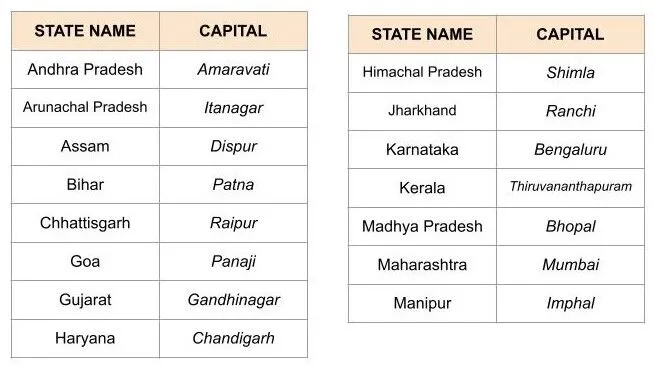
List of All 28 States of India and Their Capitals
Andhra Pradesh – Amaravati
Arunachal Pradesh – Itanagar
Assam – Dispur
Bihar – Patna
Chhattisgarh – Raipur
Goa – Panaji
Gujarat – Gandhinagar
Haryana – Chandigarh
Himachal Pradesh – Shimla
Jharkhand – Ranchi
Karnataka – Bengaluru
Kerala – Thiruvananthapuram
Madhya Pradesh – Bhopal
Maharashtra – Mumbai
Manipur – Imphal
Meghalaya – Shillong
Mizoram – Aizawl
Nagaland – Kohima
Odisha – Bhubaneswar
Punjab – Chandigarh
Rajasthan – Jaipur
Sikkim – Gangtok
Tamil Nadu – Chennai
Telangana – Hyderabad
Tripura – Agartala
Uttar Pradesh – Lucknow
Uttarakhand – Dehradun
West Bengal – Kolkata
Some capitals, like Chandigarh, serve as the capital for more than one state. Chandigarh is the capital of both Punjab and Haryana and is also a Union Territory.
Changes in the Number of States Over Time
The number of states in India has changed several times since independence. States have been reorganized based on language, administration, and development needs. One of the most significant recent changes occurred in 2019, when Jammu and Kashmir was reorganized into two Union Territories. After this change, the total number of states became 28.
Difference Between States and Union Territories
States have their own elected governments with greater autonomy, while Union Territories are governed mainly by the central government. Some Union Territories, such as Delhi and Puducherry, have legislative assemblies, but they still have less power compared to states.
Understanding this difference helps clarify why states and Union Territories are counted separately.
Why This Information Is Important for Students
Questions about how many states are in India and state capitals are very common in:
- School exams
- UPSC, SSC, and other competitive exams
- Interviews and general knowledge tests
Having a clear understanding of this topic gives students a strong foundation in Indian geography and civics.
Conclusion
To conclude, India currently has 28 states, each with its own capital city that serves as the center of administration and governance. These states together reflect the country’s rich diversity and federal structure. Knowing the names of Indian states and their capitals is essential for anyone interested in India’s political system, geography, or general knowledge.